Printable Isometric Paper
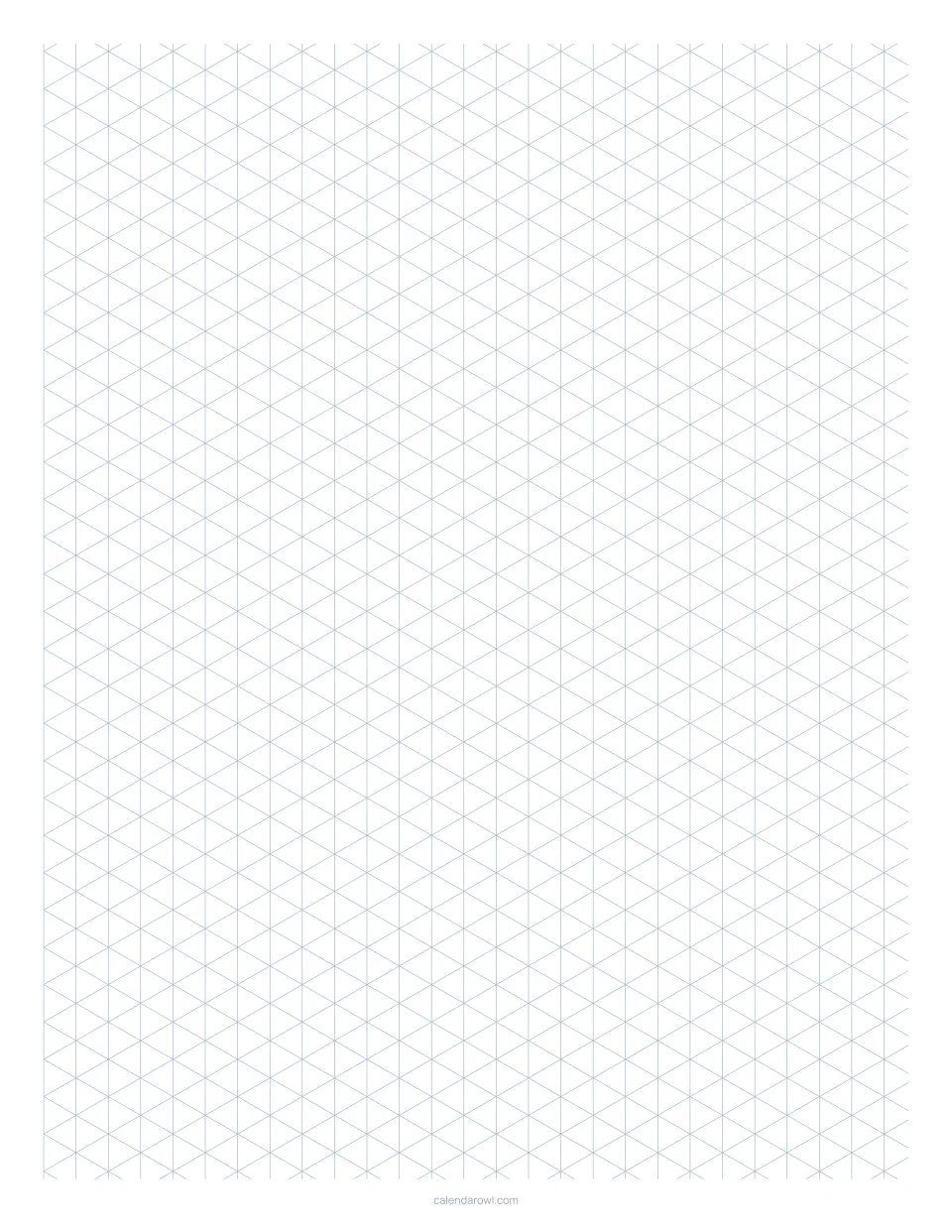
Free for personal, family and classroom use. No sign-up. PDFs print at actual size; set your printer to 100% or "Actual size".
Sizes on this page
| Size | Spacing | Good for |
|---|---|---|
| 1/4 inch | Lines 1/4 in apart | Detailed 3D sketches, small objects |
| 1 cm | Lines 1 cm apart | Larger drawings, classroom geometry |
Lines at 30, 90 and 150 degrees
Isometric paper has three sets of lines: vertical lines and two sets of slanted lines at 30 degrees from the horizontal. Together they form equilateral triangles, which lets you draw cubes, buildings and objects in 3D without measuring angles.
Who uses isometric paper
Designers sketch products and furniture, engineers draw parts, teachers use it for volume and nets of solids, and game players draw dungeon and city maps. Because the grid keeps all three axes at equal scale, measurements along any edge stay true, unlike in a perspective drawing.
How to draw a cube
- Pick a point where lines cross. Draw a vertical edge along a vertical line.
- From the top and bottom of that edge, draw two slanted edges, one to each side.
- Close the shape with vertical and slanted edges of the same length; every edge follows a grid line.
Questions and answers
What is isometric paper used for?
Technical and engineering drawings, game maps, architecture sketches, geometry lessons and 3D lettering.
What does the spacing mean?
It is the distance between neighbouring parallel lines.
Free for personal, family and classroom use. Teachers may copy for their students.