Julian Calendar (Perpetual)
Published Nov 10, 2026
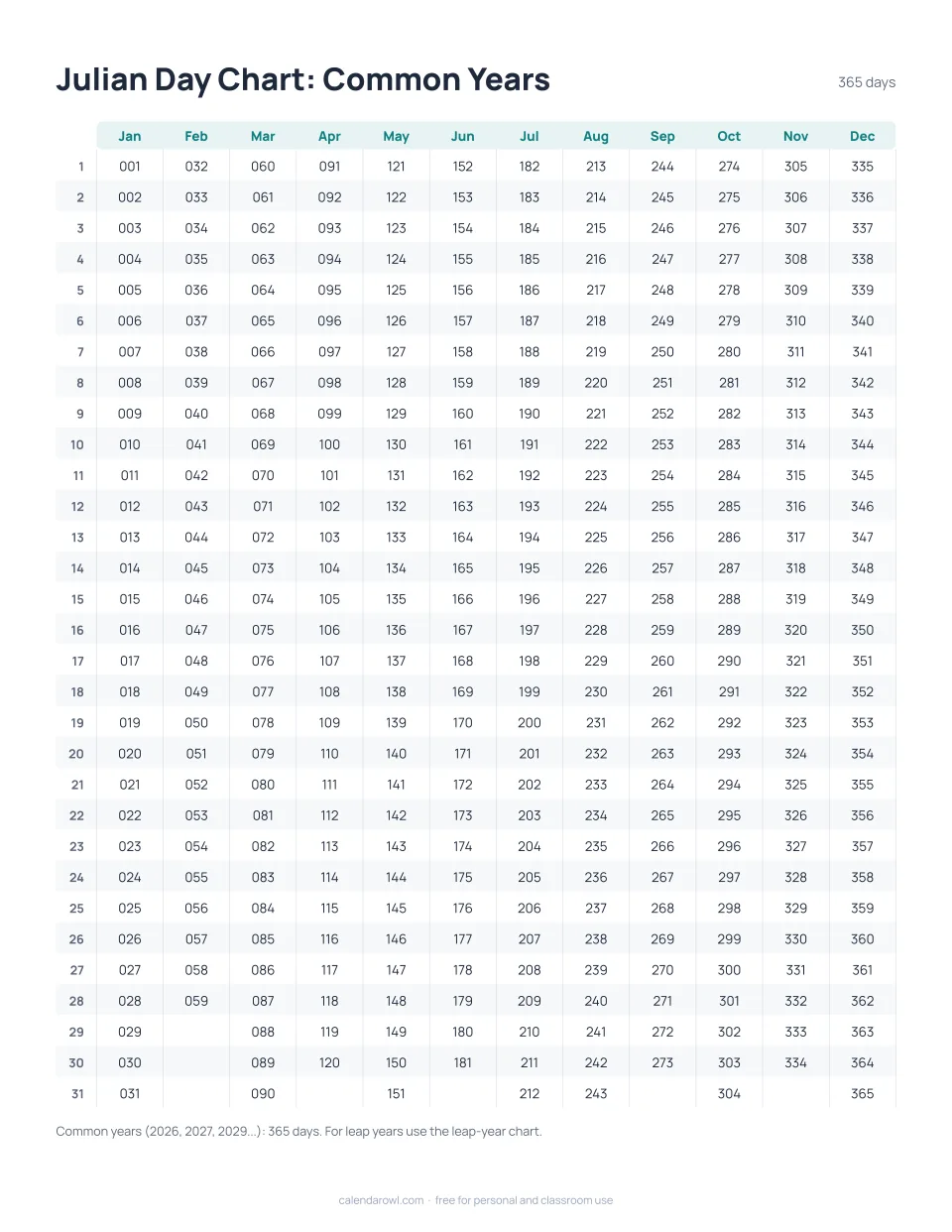
Free for personal, family and classroom use. No sign-up. PDFs print at actual size; set your printer to 100% or "Actual size".
One chart for every year
The day of the year depends only on whether the year is a leap year. The PDF has two pages: one for common years (365 days, such as 2026, 2027, 2029 and 2030) and one for leap years (366 days, such as 2028 and 2032). Pick the page that matches your year and the chart works forever.
In a leap year February 29 is day 060, so every date from March 1 to December 31 is one higher than in a common year: March 1 is day 061 and December 31 is day 366.
Julian calendar versus Gregorian calendar
The Julian calendar, introduced in 46 BC, adds a leap day every four years. That makes its year 11 minutes too long, so it drifts against the seasons. The Gregorian reform of 1582 removed three leap days every 400 years; Britain and its colonies, including America, switched in 1752, skipping 11 days. Today the gap is 13 days and it grows to 14 in 2100. Some Orthodox churches still follow the Julian calendar for feasts, which is why their Christmas falls on January 7.
2028 is the next leap year after 2027, with 366 days.
Questions and answers
How is a leap year different on the chart?
Up to February 28 the day numbers are the same. From March 1 on, every day in a leap year is one number higher, because February 29 is day 60.
Which years are leap years?
Years divisible by 4, except century years that are not divisible by 400. 2028, 2032 and 2036 are leap years; 2100 will not be.
What is the difference between the Julian and Gregorian calendars?
The Gregorian calendar, used today, drops three leap days every 400 years. The older Julian calendar keeps every fourth year as a leap year, so it is now 13 days behind; that is why some Orthodox churches celebrate Christmas on January 7.